

Most Masters previews will tell you about Matt Fitzpatrick’s US Open win at Brookline in 2022. His precision iron play. His methodical course management. His compact, repeatable swing and recent-ish distance gains.
What they won’t tell you is that a player who was already elite is measurably getting better right now — and that the course he’s walking into this week is one of the best fits in the world for his specific skill profile.
This is what the ValueFinder data shows heading into Augusta.

The Momentum Signal
Each Monday the ValueFinder model snapshots every player’s strokes gained components. From the last four snapshots, Fitzpatrick’s trajectory is one of the clearest in the entire Masters field.
His SG:Total has moved from +1.693 to +1.874 across the four weekly snapshots, a +0.181 improvement on an already exceptional base. That places him 7th in the Masters field for momentum score at +0.719, labelled <Surging> in the model.
This isn’t a one-week blip. It’s a consistent upward trend across multiple data points. A player who was already world-class is arriving at Augusta demonstrably sharper than he was a month ago.
The Course Fit
ValueFinder’s course DNA analysis is built from five years of SG correlation data across 312 player-rounds at Augusta. The findings challenge the conventional narrative:
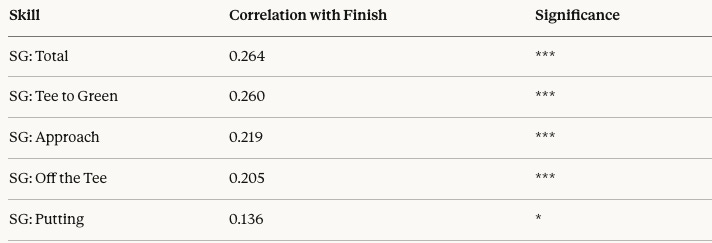
Putting is Augusta’s weakest performance discriminator. Ball-striking — specifically tee-to-green quality and approach precision into small, sloped greens — is what separates the field.
Now look at Fitzpatrick’s skill profile:
SG:Total — +1.693 (elite)
SG:Approach — +0.673 (among the best in the field)
SG:Tee to Green — +1.398 (top tier)
SG:OTT — +0.422 (solid)
SG:Putting — +0.295 (positive, not a drag)
He is strong across every component that Augusta rewards and has no meaningful weakness in the skills the course tests. His approach play specifically — the third most correlated skill with finishing position at Augusta — ranks among the highest in the entire field.
The Augusta Record
Top-10 rate of 33%. Performances trending upward with each visit. The course history score the model assigns him — built from historical finishing positions relative to field size — reflects a player whose Augusta results have been consistently solid and improving over time.
He has already demonstrated he can compete here. The question this week isn’t whether his game fits Augusta. The data answers that clearly. The question is whether the improving momentum takes him from contender to champion.
What the Model Says
The model currently has Fitzpatrick at a -1.5pp gap versus the market — meaning the market actually prices him slightly shorter than the model suggests at 24.0. He is not a value flag this week. The market has him correctly identified as a genuine contender.
But this piece isn’t about value. It’s about identifying a player whose underlying data points — momentum, course fit, skill profile, Augusta history — are all pointing in the same direction at the same time.
That combination is rare. When it happens at a major, it’s worth paying attention to.
The Bottom Line
Fitzpatrick at 24.0 on Betfair Exchange is not a longshot play. He’s a player the market correctly respects. What the ValueFinder data adds is a layer of confidence — the momentum score confirms he’s arriving at Augusta in the best form of his season, his skill profile is one of the strongest fits in the field for this specific course, and his Augusta record shows consistent improvement.
The four ValueFinder model selections for The Masters — including the model’s only automatic value flag this week — are in Tuesday’s report.
This is a separate signal. One of the best ball-strikers in the world, getting better, at a course built for his game.
ValueFinder is a golf probability model in active beta development. Momentum scores are derived from weekly SG snapshots. This is not financial advice.